
Photo by Luke Jones on Unsplash
The UK is internationally known for excellence and innovation in Artificial Intelligence (AI) and Machine Learning. AI has already transformed the way we live, work and connect with the world around us, with widespread use across society from finance and marketing to healthcare and security.
Yet for many people, AI remains an abstract and inaccessible concept, often surrounded by myths, hype and uncertainty. Many people are unaware of the extensive applications of AI and simultaneously have concerns about the ethics and challenges of its rapidly increasing use. Global research this year has shown that, although the majority of people feel AI will result in a wide range of future benefits, only 46% of people are willing to trust AI systems (ref KPMG report Trusts, attitudes and use of artificial intelligence: A global study 2025).
Children today are meeting AI before they meet critical thinking, and the Royal Society’s statement on AI in education recognises these issues and calls for education that nurtures the knowledge, skills and dispositions that young people will need to detect, understand, critically interpret and thrive in the future (ref Royal Society news AI in education).
AI has great potential as a powerful and enabling tool and the ambitions for AI in the UK are extensive, particularly involving public sector transformation. But rapidly moving science and technology can be controversial, shrouded in misinformation, or utilised for harm rather than societal benefit. In a recent survey in the UK by the Ada Lovelace Institute, public concern across all areas of AI investigated has increased, including reports of harmful personal encounters with deepfakes, false information and financial fraud (ref Ada Lovelace Institute Ada Turing survey 2025).
With a broad and inclusive reach, the science and discovery centre network is perfectly placed to play an important role in these conversations. Could science and discovery centres and museums be the space to ‘test-and-learn’ (ref The Prime Minister’s AI Exemplars programme: A portfolio approach to public sector innovation) where young people can learn the critical and relevant skills to navigate a future AI-entangled world, and where engagement and feedback from diverse communities becomes a recognised part of the research ecosystem?

The answer is yes they can, and we're pleased to announce that we have 15 centres across all four nations of the UK ready to reach 70,000 children and adults with a focus on the following cross-disciplinary themes:
- AI and its application in everyday life
- AI skills and careers
- AI engagements that platform regional diversity
From digital skills and coding, to chatbots and careers, Demystifying AI aims to break down some of the complex ideas and technologies into meaningful, interactive experiences that share the UK’s world-leading AI research and innovation with school children, teachers, families and communities across the UK.
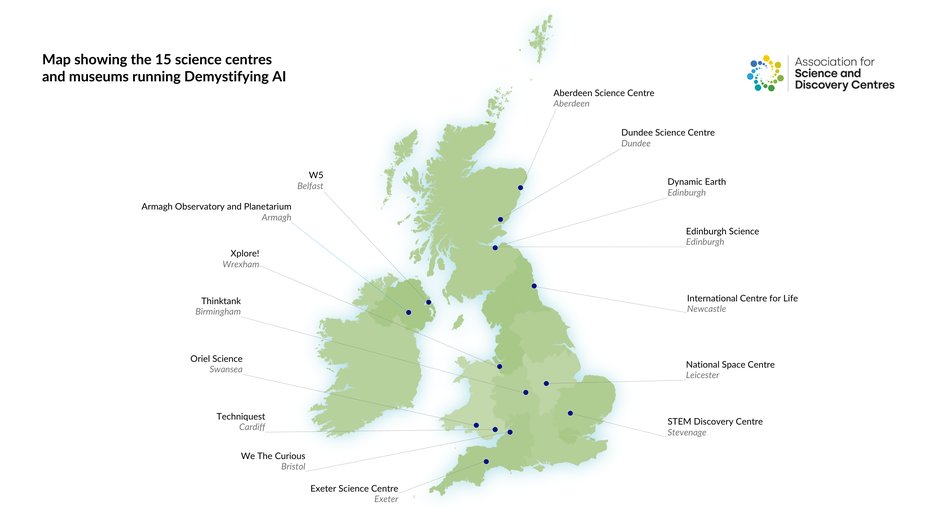
Map showing the Demystifying AI partners
Participating organisations
The 15 science centres and museums running ‘Demystifying AI’ programmes are:
In Scotland:
Aberdeen Science Centre
Dundee Science Centre
Dynamic Earth, Edinburgh
Edinburgh Science
In England:
Exeter Science Centre
International Centre for Life, Newcastle
National Space Centre, Leicester
STEM Discovery Centre, Stevenage
Thinktank, Birmingham
We The Curious, Bristol
In Northern Ireland:
Armagh Observatory and Planetarium
W5, Belfast
In Wales:
Oriel Science, Swansea
Techniquest, Cardiff
Xplore! Wrexham
The programmes running at science centres and museums across the UK from January through to late spring 2026 cover a wide range of topics, from explaining how AI and machine learning works to children as young as 7 using Lego and Minecraft, to educating the elderly on spotting fake news and helping communities to understand the opportunities emerging from their region from the growth of AI, for example in the north-east of England, which is a new AI Growth Zone, creating potential for more than 5,000 jobs and billions in private investment.
Centres aim to reach over 70,000 people during this time through hands-on, interactive exhibits, science busking, discussion panels, planetarium shows, and careers and schools talks. In some centres, the public will have direct access to scientists and engineers using AI to advance and accelerate benefits in medical, environmental and a wide range of applications for the benefit of society in ‘meet the scientist’ sessions.
Development of the programme
The Demystifying AI programme has been created and developed by ASDC, supported by a broad range of experts working across key areas in AI including sustainability, health, agriculture, ethics and the future of science. We are particularly grateful to:
- Professor Michael Wooldridge, Ashall Professor of the Foundations of Artificial Intelligence at the University of Oxford
- Zoë Brammer, Strategic Foresight Manager at Google DeepMind
- Matthew Scroggs, Research Software Engineer at University College London
- Professor Kate Royse, Director of the Hartree Centre (STFC, UKRI)
- Dr Aurelia Sauerbrei, Researcher, UKRI Metascience Fellow, University of Oxford
- Dr Xingchi Liu, AI for Science, AI Smart Facilities, STFC
- Dr Francisco Martin-Martinez, Senior Lecturer in Chemistry, King's College London
- Dr Jorge Campos-González, UKRI AI Metascience Fellow, Post-Doctoral Researcher in Agricultural, Environmental and Food Economics, University of Reading
- Tom Betts, Chief Data and AI Officer, Non-executive Director, UK Hydrographic Office
- James Martin, founder of BetterTech, a leading voice in responsible tech
- Stephen King, AI Fluency Programme Designer
This project is funded by UK Research and Innovation (UKRI), with project development supported by Science Technology Facilities Council (STFC, part of UKRI).