
Photo by Lee Pullen
Demystifying AI: From Algorithms to Everyday Life demonstrates how nationally coordinated, regionally delivered public engagement and participation can strengthen public attitudes, build confidence and agency, and increase understanding of how emerging technologies can benefit people and communities across the UK.
Download the case study report showcasing all of the 15 programmes run by science engagement organisations around the UK:
ASDC Demystifying AI Case Studies Report (June 2026)
Download the external project evaluation report:
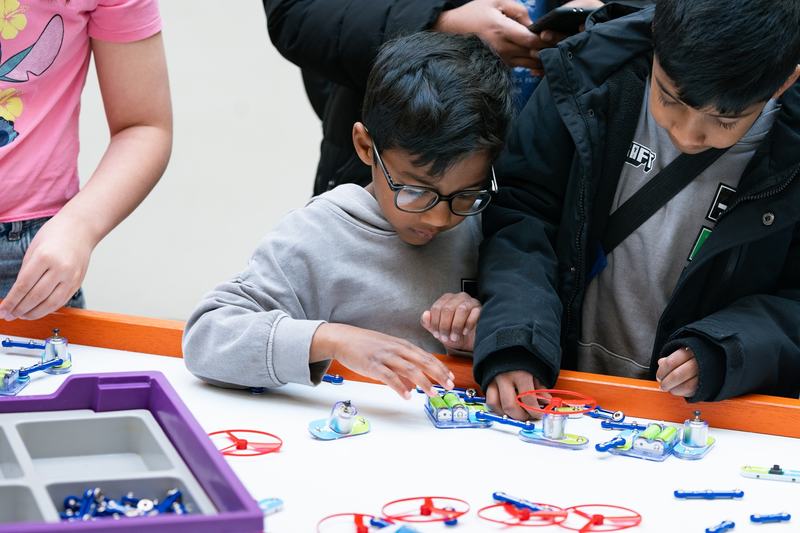
From January to April 2026, we tested a rapid, scalable model for engaging the public with Artificial Intelligence (AI) through trusted, local institutions.
From digital skills and coding, to chatbots and careers, 'Demystifying AI' aimed to break down complex ideas and technologies into meaningful, interactive experiences that share the UK’s world-leading AI research and innovation with school children, teachers, families and communities across the UK.
The programme significantly exceeded expectations within just four months, reaching more than 70,000 participants through 1,094 events and activities, including over 44,000 children and young people, 24,000 adults, 294 schools, and 82 community groups across all four nations of the UK.
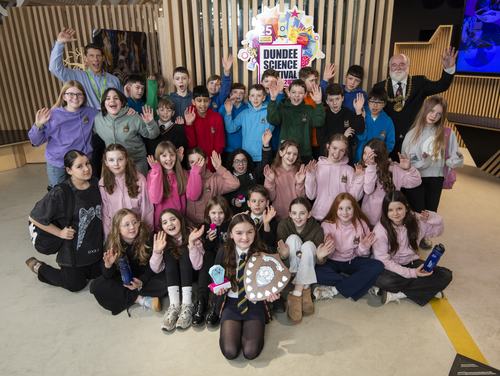
Fifteen Science and Discovery Centres and Museums brought together interdisciplinary researchers from across all UKRI mission areas, with wider business, education and community partners to support the public’s involvement with science and emerging technologies. They focused on the following cross-disciplinary themes:
- AI and its application in everyday life
- AI skills and careers
- AI engagements that platform regional diversity
Centre’s used hands-on activities, facilitated conversations, 'Meet the Researcher' events, creative and immersive spaces, local scientific case studies and community-based delivery to enable audiences to explore AI critically and collaboratively.
Find out how they transformed AI from an abstract, complex and intimidating concept into something playful, accessible and relevant to everyday life.
The programme achieved measurable impacts on public confidence and understanding. Following participation 75% improved their understanding of AI's capabilities and limitations, 65% felt more able to critically evaluate AI, 64% reported greater confidence about when to trust AI, and perceptions of AI’s public benefit increased from 52% to 68%, with negative perceptions falling from 32% to 10%.
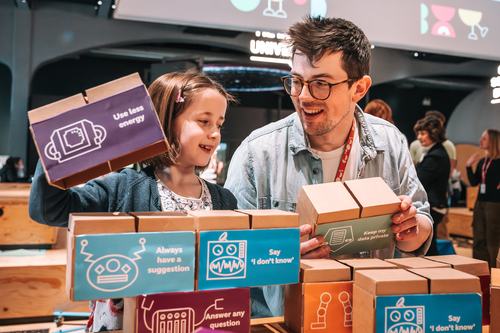
The 2025 Public Attitudes to Science survey (PAS2025) highlighted that information alone does not build trust in emerging technologies.
We believe that trust can be built when people are able to participate, ask questions, test technologies, discuss ethical concerns and engage directly with local science, researchers and innovators that are relevant to them.
'Demystifying AI' was created by the Association for Science and Discovery Centres (ASDC), partnering with 15 Science and Discovery Centres and Museums across the UK. It was funded by UK Research and Innovation (UKRI), with support and guidance from the Science and Technology Facilities Council (STFC, part of UKRI).
The programme was supported by a broad range of experts working across key areas in AI including sustainability, health, agriculture, ethics and the future of science. We are particularly grateful to:
- Professor Michael Wooldridge, Ashall Professor of the Foundations of Artificial Intelligence at the University of Oxford
- Zoë Brammer, Strategic Foresight Manager at Google DeepMind
- Matthew Scroggs, Research Software Engineer at University College London
- Professor Kate Royse, Director of the Hartree Centre (STFC, UKRI)
- Dr Aurelia Sauerbrei, Researcher, UKRI Metascience Fellow, University of Oxford
- Dr Xingchi Liu, AI for Science, AI Smart Facilities, STFC
- Dr Francisco Martin-Martinez, Senior Lecturer in Chemistry, King's College London
- Dr Jorge Campos-González, UKRI AI Metascience Fellow, Post-Doctoral Researcher in Agricultural, Environmental and Food Economics, University of Reading
- Tom Betts, Chief Data and AI Officer, Non-executive Director, UK Hydrographic Office
- James Martin, founder of BetterTech, a leading voice in responsible tech
- Stephen King, AI Fluency Programme Designer
Participating organisations
The 15 science centres and museums running ‘Demystifying AI’ programmes are:
In Scotland:
Aberdeen Science Centre
Dundee Science Centre
Dynamic Earth, Edinburgh
Edinburgh Science
In England:
Exeter Science Centre
International Centre for Life, Newcastle
National Space Centre, Leicester
STEM Discovery Centre, Stevenage
Thinktank, Birmingham
We The Curious, Bristol
In Northern Ireland:
Armagh Observatory and Planetarium
W5, Belfast
In Wales:
Oriel Science, Swansea
Techniquest, Cardiff
Xplore! Wrexham
This project is funded by UK Research and Innovation (UKRI), with project development supported by Science Technology Facilities Council (STFC, part of UKRI).